
Car Insurance for Uber & Lyft Drivers

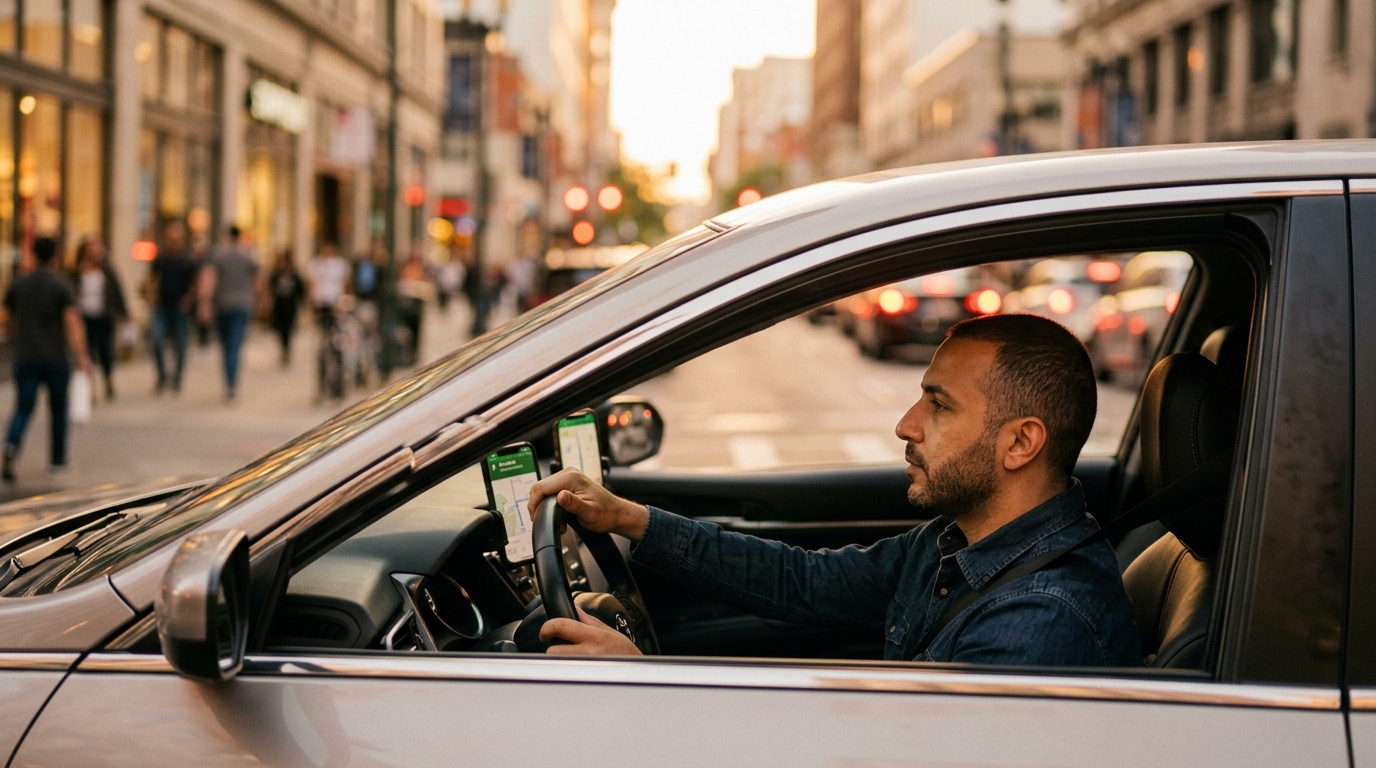
Uber insurance and Lyft insurance are not single policies but a patchwork of coverage that shifts throughout every ride. A driver's personal auto policy handles some situations, the rideshare platform's commercial policy handles others, and there is a middle window where coverage can be thin or nonexistent. This article walks through the three rideshare periods, what Uber's and Lyft's policies actually pay for, and the endorsements that fill the gaps.
In this article
The Three Rideshare Coverage Periods, Explained
Rideshare insurance breaks down into three distinct periods that every Uber and Lyft driver moves through during a shift. Understanding which policy applies in each period is the first step to knowing where coverage actually exists.
Period 1 begins the moment the driver logs into the app and ends when they accept a ride request. During this window, Uber and Lyft provide only limited liability coverage — typically $50,000 per person and $100,000 per accident for bodily injury, plus $25,000 for property damage. There is no collision, comprehensive, or medical coverage from the platform. The driver's personal auto policy technically applies, but most personal policies exclude any driving that involves compensation.
Period 2 starts when the driver accepts a ride request and lasts until the passenger gets in the car. During this leg, the rideshare company's commercial policy expands to $1 million in third-party liability, plus uninsured and underinsured motorist coverage.
Period 3 covers the passenger's actual trip. The $1 million liability policy remains active, and contingent collision and comprehensive coverage becomes available — but only if the driver already carries those coverages on their personal policy.
What Uber and Lyft's Commercial Policies Actually Cover
Uber insurance and Lyft insurance are underwritten by commercial carriers like Progressive, Allstate, and Liberty Mutual. The core coverage during Periods 2 and 3 looks similar across both platforms, but the details matter.
- Third-party liability — $1 million per accident during Periods 2 and 3, covering injuries to passengers, other drivers, pedestrians, and property damage.
- Uninsured and underinsured motorist coverage — limits vary by state, typically starting at $250,000, protecting the driver and passenger if an at-fault motorist has no insurance or too little of it.
- Contingent collision and comprehensive — pays for damage to the rideshare driver's vehicle during Periods 2 and 3, but only if the driver already carries collision and comprehensive on their personal policy. The deductible is $2,500 for both Uber and Lyft.
- Period 1 limited liability — $50,000 per person / $100,000 per accident bodily injury and $25,000 property damage, applied only when a personal policy denies the claim first.
Notably absent: medical payments coverage for the driver, personal injury protection in most states, and any vehicle coverage when the app is off.
The Gaps That Leave Rideshare Drivers Exposed
The holes in this stack are what push most drivers toward additional coverage. Five specific issues come up repeatedly in claim disputes.
- Period 1 liability limits are low. The $50,000/$100,000/$25,000 during app-on-but-waiting time is well below the actual cost of a serious accident. A totaled luxury vehicle plus one injury can blow through $100,000 quickly.
- Contingent collision has a $2,500 deductible. A typical personal policy carries a $500 to $1,000 deductible. If the rideshare driver's car takes $4,000 in damage during a ride, they pay $2,500 out of pocket before Uber or Lyft's policy contributes.
- Personal policies exclude commercial use. Most standard auto policies contain a livery or for-hire exclusion. A carrier can deny a claim if the driver was logged into the app — even during Period 1 — and had not disclosed the rideshare activity.
- Insurers can nonrenew or cancel. A carrier that discovers undisclosed rideshare driving after a claim may cancel the policy, and the cancellation follows the driver when shopping for replacement coverage.
- Medical payments and PIP gaps. Uber and Lyft's policies do not cover the driver's own medical bills after an at-fault accident. Health insurance or personal injury protection has to fill in — and PIP may be voided by the same commercial-use exclusion.
Ready to compare car insurance rates?
Fresh side-by-side quotes from three or more insurers take about ten minutes.
See our quote guideRideshare Endorsements Are the Cheap Fix
A rideshare endorsement is an add-on to an existing personal auto policy that extends coverage through Period 1 and, in some states, further. Uber insurance endorsements are the simplest and cheapest way to close the biggest gap.
Endorsements typically cost $15 to $40 per month, depending on state, driving record, and vehicle. Common providers include:
- State Farm — Rideshare Driver Coverage extends personal collision and comprehensive through all three periods in most states
- Geico — sells a hybrid rideshare policy rather than a rider
- Progressive — rideshare endorsement available in most states
- Allstate — Ride for Hire endorsement
- USAA — available for eligible members
- Farmers and Erie — available in select states
Availability varies. Drivers in Texas or California will find nearly every major carrier participates; drivers in smaller markets may have two or three options. The endorsement does two important things: it keeps the personal policy from voiding during commercial use, and it applies the driver's own collision and comprehensive coverage — with the personal deductible instead of the $2,500 platform deductible. That single change often justifies the monthly cost after one incident.
When a Commercial Auto Policy Makes More Sense
Not every driver fits into an endorsement. A commercial auto policy — a separate policy written specifically for for-hire vehicle use — makes sense when driving hours cross a certain threshold or when the driver also does food delivery, package delivery, or non-rideshare passenger transport.
The rough dividing line: a driver working part-time, under 20 hours a week on a single platform, is generally best served by an endorsement. A driver running 30 or more hours across multiple platforms — Uber, Lyft, DoorDash, Instacart — typically saves money and headaches with a commercial policy covering every commercial use in one place.
| Feature | Rideshare Endorsement | Commercial Auto Policy |
|---|---|---|
| Annual cost | $180 to $500 added to base policy | $3,000 to $7,000 total |
| Best for | Part-time, one platform | 30+ hours/week, multiple platforms |
| Coverage gaps | May stop at Period 2 in some states | Continuous across all commercial use |
| Liability limits | Personal policy limits carry over | Higher commercial limits available |
What Rideshare Coverage Costs and How to Shop It
Adding rideshare coverage to a personal auto policy usually raises the annual premium by $180 to $500 — roughly 10 to 25 percent over the base cost. Rates vary heavily by state; Michigan and Louisiana drivers pay more, while Ohio and Vermont drivers pay less.
Shopping the coverage is straightforward because only a handful of carriers write it. The most cost-effective approach: start with the current insurer (adding an endorsement to an existing policy is often the cheapest option), then compare against Geico, Progressive, and State Farm. Regional carriers like Erie and Auto-Owners sometimes beat the national names in the Midwest and Northeast.
Two shopping details matter. First, disclose all rideshare activity upfront — a carrier that quotes without knowing about rideshare will simply cancel later. Second, ask specifically which periods the endorsement extends to. Some endorsements cover only Period 1; better ones extend the driver's own collision and comprehensive through Period 3, replacing the $2,500 platform deductible with the personal-policy deductible for the entire shift.
Frequently Asked Questions
Does my regular car insurance cover me while driving for Uber?
In almost every case, no. Standard personal auto policies contain a livery or for-hire exclusion that denies claims when the driver is being paid to transport passengers. The exclusion often applies the moment the app is switched on, even before accepting a ride. Adding a rideshare endorsement or switching to a rideshare-friendly policy is the standard fix.
What happens if I have an accident during Period 2 with only Uber's coverage?
Uber and Lyft's Period 2 policy pays only $50,000 per person and $100,000 per accident in bodily injury and $25,000 in property damage. That is enough for minor accidents, but a serious injury or high-value vehicle can exceed those limits quickly. Anything above the limit becomes the driver's personal responsibility, and there is no coverage for damage to the driver's own car in Period 2 unless a rideshare endorsement is in place.
How much does a rideshare endorsement cost?
Most endorsements run $15 to $40 per month, or roughly $180 to $500 added to an annual premium. Cost depends on the state, the vehicle, the driver's record, and the carrier. State Farm and Geico are often on the lower end, while specialty carriers offering broader all-period coverage tend to run higher.
Do Uber and Lyft's policies cover damage to my car?
Only during Periods 2 and 3, only if the driver already carries collision and comprehensive on their personal policy, and only after a $2,500 deductible. There is no vehicle coverage at all during Period 1. This is the single biggest reason drivers add a rideshare endorsement, which typically lowers the deductible to the personal-policy amount.
Can my insurance company drop me for driving Uber?
Yes. A personal auto insurer that discovers undisclosed rideshare driving — usually after a claim — can nonrenew or cancel the policy on the grounds of misrepresentation. The cancellation follows the driver on their record and can raise rates when shopping for replacement coverage. Disclosing rideshare activity upfront and buying an appropriate endorsement avoids the problem entirely.