
Water Damage Coverage: Sudden vs Gradual
Water damage coverage sits inside every standard homeowners policy, but it does not pay out for every wet ceiling or warped floor a homeowner discovers. Insurers sort these claims into two buckets — sudden and accidental incidents, which are generally covered, and gradual damage from slow leaks or wear, which is almost always excluded. The line between those two categories decides whether a $12,000 kitchen becomes a paid claim or a personal expense.
In this article
- "Sudden and Accidental" — The Phrase That Unlocks Coverage
- The Gradual Damage Exclusion
- The Under-Sink Leak Fight — How Claims Actually Get Decided
- Sewer Backup and Sump Pump — The Endorsement Most People Skip
- Water Damage vs Flood Damage — the Line That Trips People Up
- How to File a Water Damage Claim Without Getting Denied
"Sudden and Accidental" — The Phrase That Unlocks Coverage
Standard HO-3 and HO-5 homeowners policies extend water damage coverage to losses that happen quickly and by surprise. The classic scenarios that adjusters approve without much argument include a pipe bursting when temperatures drop below freezing, a washing machine supply hose blowing off the valve, a water heater tank rupturing overnight, an ice dam forcing meltwater under shingles, or a toilet supply line snapping while the family is at work. In each case the failure point is a definable moment, not a slow buildup over months.
Payouts on these claims are among the largest in homeowners insurance. Industry data typically puts the average water damage claim in the $10,000 to $15,000 range, but a burst pipe on a second floor that soaks hardwood, drywall, and cabinetry on the level below can easily push $50,000 to $80,000. Coverage generally includes tear-out of damaged materials, drying and dehumidification, and replacement at actual cash value or replacement cost depending on the policy form. What it does not cover is the source of the failure itself — the busted pipe or the failed water heater is on the homeowner.
The Gradual Damage Exclusion
The single biggest cause of claim denials is language buried in every homeowners policy that excludes constant or repeated seepage or leakage of water over a period of 14 days or more. That 14-day rule is the standard trigger insurers use to reject claims where evidence — water staining, mold growth, rotted wood — suggests the leak was not new. Examples that typically fall on the excluded side of the line:
- A shower pan that has been weeping into the subfloor for a year, discovered during a bathroom remodel
- A slab leak that finally surfaces after months of a slightly higher water bill
- A refrigerator ice maker line that dripped behind the fridge until the flooring buckled
- A slow roof leak with visible staining on ceiling tiles or drywall
- Toilet flange seals that leaked into the subfloor and rotted the joists
- Any damage tagged as mold, rot, corrosion, or rust rather than fresh water intrusion
The rationale carriers use is that these are maintenance issues, and maintenance is the homeowner's responsibility. The tricky part is that many sudden failures start as slow leaks — which sets up the argument that plays out on kitchen floors nationwide.
The Under-Sink Leak Fight — How Claims Actually Get Decided
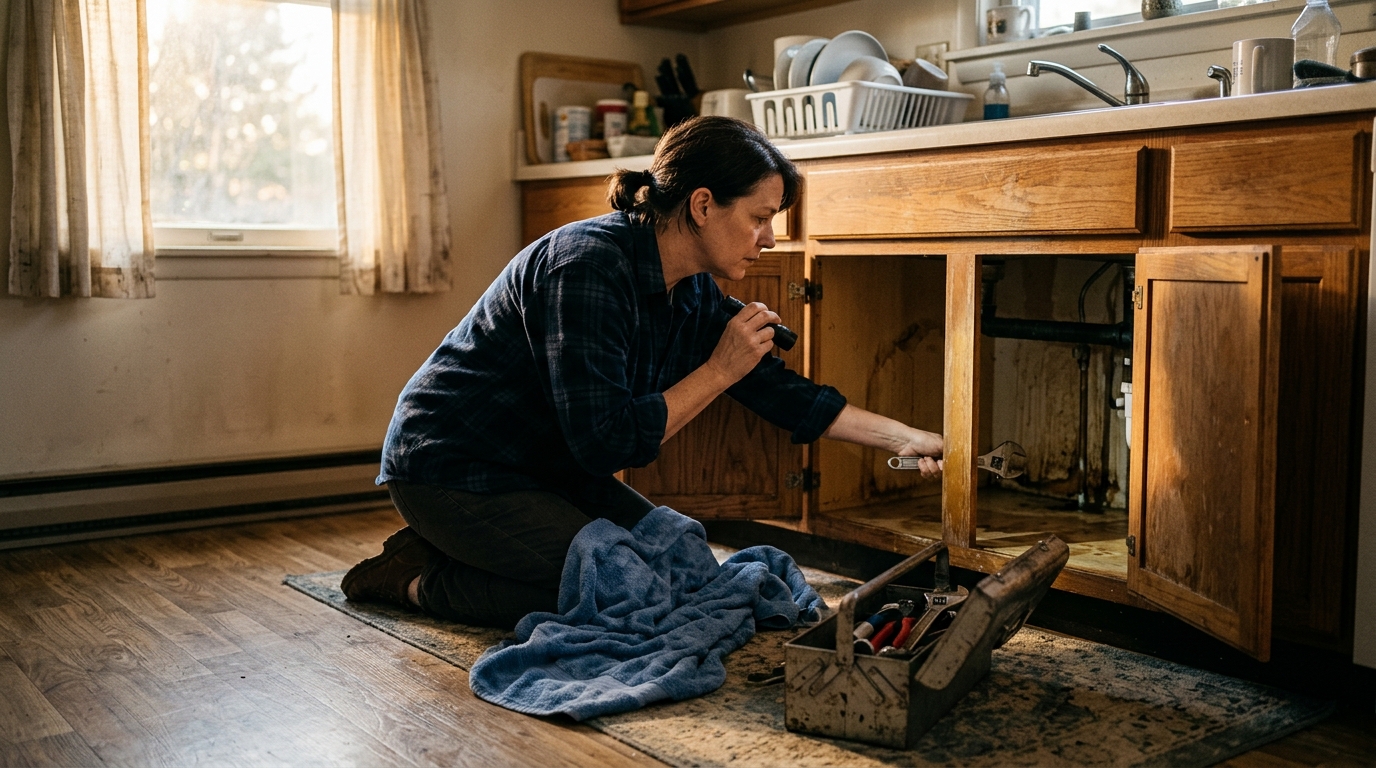
A homeowner opens a lower cabinet, finds the base rotted through and the drywall behind it black with mold. The plumber traces the source to a failed compression fitting on a hot water supply line. Was the fitting an event, or the endpoint of a long slow drip? That fight decides tens of thousands of coverage dollars per year. When arguing this type of claim, the sequence that usually works is:
- Document the leak site with dated photos and video before any cleanup starts, capturing both the failure point and the surrounding staining pattern.
- Have the plumber write a repair invoice that explicitly states the failure mode — for example, fitting cracked, sudden discharge — rather than a vague leak repair.
- Report the claim within 48 to 72 hours; long reporting delays are frequently cited by adjusters as evidence of gradual damage.
- If the adjuster denies as gradual, ask for the denial in writing citing the specific policy language, then push for partial coverage on the sudden component even if long-term staining is excluded.
- Escalate to the state department of insurance if the carrier will not honor the sudden portion — most states require carriers to segment mixed claims.
Some claims end up split: the carrier pays for the drying, cabinet replacement, and drywall, while excluding the rotted subfloor as long-term deterioration.
Time to review your homeowners policy?
Comparing quotes every 12-24 months often surfaces discounts your current insurer will not volunteer.
How to shop home insuranceSewer Backup and Sump Pump — The Endorsement Most People Skip
Water that enters the home through a floor drain, toilet, or basement wall during heavy rain is not covered by a standard homeowners policy. Sewer and drain backup, along with sump pump failure and discharge, sits behind a separate endorsement that carriers sell for roughly $50 to $150 a year depending on state and coverage limit. The endorsement generally adds $5,000 to $25,000 in $5,000 increments, though some insurers now sell six-figure limits.
This coverage matters most in three situations: a municipal sewer main surge during heavy rainfall that pushes waste up through basement floor drains, a sump pump that dies during a summer storm when the electricity is out, and a lateral sewer line collapse that backs the whole system into the lowest fixture in the house. A finished basement claim can hit $30,000 fast between drywall, flooring, mechanicals, and stored contents. Without the endorsement, all of it comes out of pocket. Homes with basements, mature trees over the sewer lateral, or a history of neighborhood backups are the obvious candidates for adding it.
Water Damage vs Flood Damage — the Line That Trips People Up
Homeowners water damage coverage stops at the ground. Anything that arrives as surface water — river overflow, hurricane storm surge, flash flooding, or heavy rain pooling and seeping through the foundation — is defined as flood damage and excluded from every standard homeowners policy in the country. It requires a separate National Flood Insurance Program (NFIP) policy or private flood insurance. The distinction is not academic; it decides most claims after named storms.
| Scenario | Homeowners | Flood policy |
|---|---|---|
| Wind rips off shingles, rain enters attic | Covered | Not needed |
| Storm surge pushes ocean water into first floor | Excluded | Covered |
| Burst pipe soaks the kitchen | Covered | Not applicable |
| Heavy rain overwhelms yard, seeps into basement | Excluded | Covered |
| Sewer main backs up during storm | Endorsement only | Sometimes covered |
The gray area every hurricane produces: was the damage from wind-driven rain through a compromised roof (covered) or from rising water outside (flood)? Adjusters look at mud lines, debris height, and interior damage patterns to make the call, and it is worth challenging in writing when the split matters to the payout.
How to File a Water Damage Claim Without Getting Denied
Fast, documented, and well-mitigated claims get paid. Slow, poorly documented claims get argued down or denied. The homeowner's post-loss duties, spelled out in every policy, include stopping the water, protecting property from further damage, and making a prompt claim. The practical checklist:
- Shut off the water at the fixture valve or the main immediately, and photograph the shutoff.
- Take video walking through every affected room before touching anything, then dated photos of specific damage.
- Save damaged items in a garage or spare room; insurers can require inspection of contents claims.
- Call a water restoration company within 24 hours — commercial dehumidifiers running within 48 hours often prevent mold, which the policy will not cover if it grew from unreasonable delay.
- File the claim by phone or app the same day, and email the carrier a written summary with photos attached.
- Keep every receipt — hotels if displaced, meals if the kitchen is unusable, mitigation invoices — all of which fall under additional living expenses on most policies.
Denials are appealable. State insurance departments in Texas, Florida, California, and New York all publish complaint portals that carriers respond to, and a well-documented file wins more of these appeals than homeowners typically assume going in.
Frequently Asked Questions
Does homeowners insurance cover water damage from a broken pipe?
Yes — a sudden pipe burst is one of the most consistently covered scenarios in a standard homeowners policy. Insurers pay for water removal, drying, and repair of damaged floors, walls, and belongings, though the pipe itself and any pre-existing corrosion are not covered. Denials most often occur when evidence shows the pipe had been leaking slowly before the final failure.
What is the 14-day rule in home insurance?
The 14-day rule refers to policy language excluding water damage caused by seepage or leakage lasting 14 days or longer. If an adjuster determines a leak had been active for two weeks or more before discovery, the claim is generally denied as gradual damage. It is the single most-cited exclusion in denied water claims.
Does homeowners insurance cover a slow leak under the sink?
Usually not, if adjusters can prove the leak persisted for weeks or months. Coverage sometimes applies to the sudden failure moment — a fitting that finally cracked — while excluding the rotted cabinet and subfloor as long-term deterioration. Documentation and a plumber's failure-mode statement are what tip these mixed claims one way or the other.
Is flood damage covered by homeowners insurance?
No. Flood damage — any water that arrives from outside the home as rising surface water — is excluded from every standard homeowners policy and requires a separate NFIP policy or private flood insurance. This includes storm surge, river overflow, and heavy rain seeping in through the foundation. Wind-driven rain that enters through a storm-damaged roof, however, does fall under homeowners.
How much water damage coverage does a standard policy include?
There is no separate limit for water damage on most homeowners policies — the dwelling coverage limit (Coverage A) applies, meaning payouts can reach the full policy limit minus the deductible. Personal property is covered under Coverage C at a percentage of the dwelling limit. Sewer backup and sump pump losses sit behind their own endorsement limit, typically $5,000 to $25,000.