
Does Insurance Cover Windshield Replacement? Auto Glass Coverage Explained

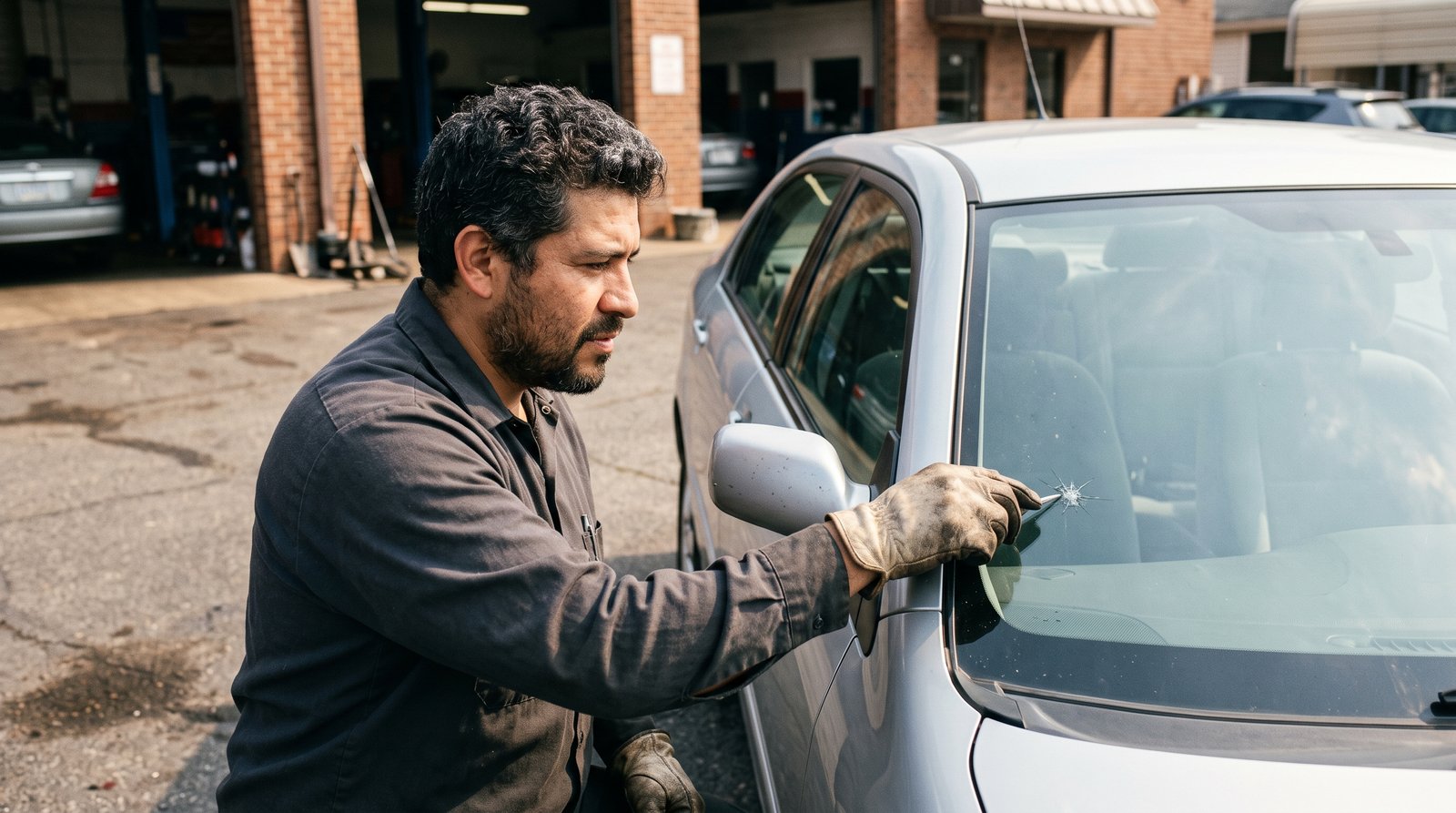
Does insurance cover windshield replacement? Usually yes — but only if you carry comprehensive coverage, and in most states your comprehensive deductible applies to the glass exactly as it would to hail damage or a stolen car. That one fact decides nearly every glass question that follows, including the one that catches owners of newer cars out: who pays to recalibrate the cameras sitting behind the new windshield.
In this article
- Glass damage is a comprehensive claim, not collision
- Does insurance cover windshield replacement without a deductible?
- Full glass coverage and zero-deductible endorsements
- Three states put glass rules directly into law
- Repair or replace, and why your insurer prefers a repair
- ADAS recalibration is the modern cost driver
- OEM or aftermarket glass, and who chooses the shop
- Does a glass claim raise your rates?
Glass damage is a comprehensive claim, not collision
Auto glass falls under comprehensive coverage — the part of a policy that pays for damage that is not a crash. A rock thrown up by a truck, a hailstorm, a falling branch, a break-in: all comprehensive. Collision only responds when your car hits something or something hits it, so it is the wrong coverage for the chip that appeared on the interstate. Our guide to comprehensive vs collision coverage covers that split in full.
The practical consequence is that a glass claim is a first-party claim against your own policy, with no other driver and no fault to argue about. It moves faster than an accident claim, never involves the other side's insurer, and is treated differently at renewal. The other perils sitting on the same line of your policy are listed in what comprehensive coverage actually covers.
One thing follows immediately. If you carry liability only, there is nothing on your policy that pays for glass. Comprehensive has to be there first.
Does insurance cover windshield replacement without a deductible?
In most of the country, no. Your comprehensive deductible applies to a windshield the same way it applies to any other comprehensive loss: you pay the deductible, the insurer pays the rest. If the replacement costs less than your deductible, the insurer pays nothing at all and you have simply told your carrier you had a loss.
That is why a small chip is often cheaper to handle yourself. Get the shop's price first, set it against your comprehensive deductible, and only then decide whether opening a claim is worth it — the same arithmetic we work through in small claim vs pay out of pocket.
Two things change that math: buying separate glass coverage, or living in a state whose legislature has already taken the deductible off glass for you.
Full glass coverage and zero-deductible endorsements
Many insurers sell an optional add-on — usually called full glass coverage, glass buy-back or a zero-deductible glass endorsement — that removes the deductible for glass losses only. Everything else on the comprehensive line keeps the normal deductible; only the windshield, side windows and rear glass are treated differently.
Whether you can buy it, what it is called and what it adds to your premium are all set by the insurer and filed state by state, so there is no universal answer and no universal price. Some carriers do not offer it at all in some states. Ask your agent two specific questions: does it cover replacement as well as repair, and does it cover the recalibration work described further down this page.
It is worth most to drivers who park outdoors, commute on highways where gravel travels, or carry a high comprehensive deductible.
Ready to compare car insurance rates?
Fresh side-by-side quotes from three or more insurers take about ten minutes.
See our quote guideThree states put glass rules directly into law
Glass coverage is regulated at state level, and a few legislatures have written rules over the top of whatever the policy says. Three are confirmed in current statute.
| State | What the law does | Statute |
|---|---|---|
| Florida | No deductible on windshield damage | s. 627.7288 |
| Kentucky | Glass-only claims paid in full | KRS 304.20-060 |
| South Carolina | No deductible on safety glass | s. 38-77-280(B) |
Florida's statute says a comprehensive policy's deductible provisions "shall not be applicable to damage to the windshield." South Carolina's says a physical damage or policy deductible "does not apply to automobile safety glass" — and its Department of Insurance is blunt that this is not free glass, because you still have to be carrying comprehensive on that vehicle. Kentucky's, amended in 2024, requires a comprehensive or other-than-collision policy to pay glass-only claims "without regard to any deductible or minimum amount."
If you are not in one of these three, assume your deductible applies until your declarations page says otherwise.
Repair or replace, and why your insurer prefers a repair
A chip is frequently repaired rather than replaced: resin is injected into the break, cured and polished flat. Insurers like that outcome, because a repair costs far less than a new windshield and stops a small break from spreading into a crack that forces a replacement later. That is why many carriers waive the deductible on a repair even when they would charge it on a replacement.
Whether a break can be repaired at all depends on its size, its depth and where it sits. Damage in the driver's direct line of sight is usually replaced rather than repaired, because even a good repair leaves some distortion in the glass. Long cracks, breaks running to the edge of the windshield and damage that has gone through both layers generally cannot be repaired either. The shop makes that call with the glass in front of it — nobody can make it from a photograph.
Move quickly either way. Temperature swings, rough roads and car washes all encourage a chip to run.
ADAS recalibration is the modern cost driver
On a car built in the last several years, the windshield is not just glass. In the federal rulemaking behind the automatic emergency braking standard, NHTSA notes the cameras those systems rely on are "typically mounted behind the front windshield near the rearview mirror," protected there from dirt and debris. Those same forward-facing cameras feed lane departure warning, which NHTSA describes as monitoring lane markings to flag when the car is drifting.
Take the windshield out and the camera's aim goes with it. NHTSA addressed this directly in the 2024 AEB final rule, acknowledging industry concern about "glass replacement and the impact that has on FCW/AEB sensors" and noting that glass replacement firms already work with manufacturers "to ensure proper sensor calibration." The same record includes a safety-research example of a skewed camera after a windshield replacement that gave the driver no warning at all.
So ask two questions before authorizing work: is recalibration included in this quote, and is it covered under the claim? Kentucky and Florida both name recalibration of driver assistance systems inside their glass statutes, which tells you how real a line item it has become. And the federal AEB standard covers passenger cars and light trucks from September 1, 2029, so this is only going to get more common.
OEM or aftermarket glass, and who chooses the shop
Replacement glass comes either through the vehicle manufacturer's supply chain (OEM) or from an independent maker built to an equivalent specification (aftermarket). Which you get is a policy question, not a preference: some policies promise OEM parts, some promise parts of like kind and quality, and some sell an OEM endorsement separately. Read the physical damage wording.
State law sets a floor under that. Florida, for one, bars an insurer from requiring replacement parts that are not "at least equivalent in kind and quality" to what was damaged, judged on fit, appearance and performance, and requires the insurer to hand you a copy of the written estimate a partial-loss settlement rests on.
Shop choice is usually yours. Kentucky's glass statute says an insured making a first-party glass claim cannot be required to use a particular shop in order to be paid, while still allowing insurers to run a network. Steering rules differ by state, so if a carrier pushes hard toward one shop, ask your state department of insurance where the line sits.
Does a glass claim raise your rates?
Not the way an at-fault accident does, and the reason is structural. The NAIC describes two separate mechanisms behind what you pay: underwriting, where the insurer decides whether to take the risk, and rating, where it prices the risk it took. A comprehensive glass loss is not fault-based, so it generally does not carry the surcharge an at-fault collision attracts under a rating plan.
"Generally" is doing real work there. The insurer still sees the claim, and claim frequency — how often you turn up, whatever the reason — can feed into eligibility, tier placement and renewal. One chip repair is unlikely to matter; a run of glass claims in a short window is a different conversation. If your premium has already moved, why did my car insurance go up walks through the usual causes.
Glass rules are set state by state and written insurer by insurer. Your own declarations page and policy wording decide what applies to you, and your state department of insurance can confirm what your state requires.
Frequently Asked Questions
Will my insurance pay to repair a small windshield chip?
Often yes, and often with no deductible. Many insurers waive the deductible on a resin repair because it costs them far less than the replacement it prevents. Confirm it before the work starts, though — a waiver on repairs does not automatically mean a waiver on replacements.
Do I need comprehensive coverage to claim a cracked windshield?
Yes. Glass sits under comprehensive, so a liability-only policy has nothing to pay the claim from. South Carolina's Department of Insurance makes the point explicitly even for its own no-deductible rule: the vehicle has to carry comprehensive before the insurer will replace the windshield.
Is full glass coverage worth buying?
It depends on your deductible and your exposure. A driver with a high comprehensive deductible who parks outdoors or commutes past gravel trucks gets the most from it; a garaged car with a low deductible gets less. Ask what it adds to the premium and whether it includes recalibration, then weigh that against the cost of one replacement.
Who pays for ADAS recalibration after a windshield replacement?
When the glass loss itself is covered, the recalibration the replacement makes necessary normally goes on the same claim — Kentucky and Florida both name recalibration in their glass statutes. Get it written into the estimate before work begins, because a camera can be left misaimed without any warning appearing on the dash.
Can my insurer make me use a specific glass shop?
Usually not, but the rules are state-specific. Kentucky bars an insurer from requiring a particular glass shop as a condition of paying a first-party glass claim, while still letting insurers maintain networks. If your carrier is pushing hard toward one shop, your state department of insurance can tell you where the line sits in your state.